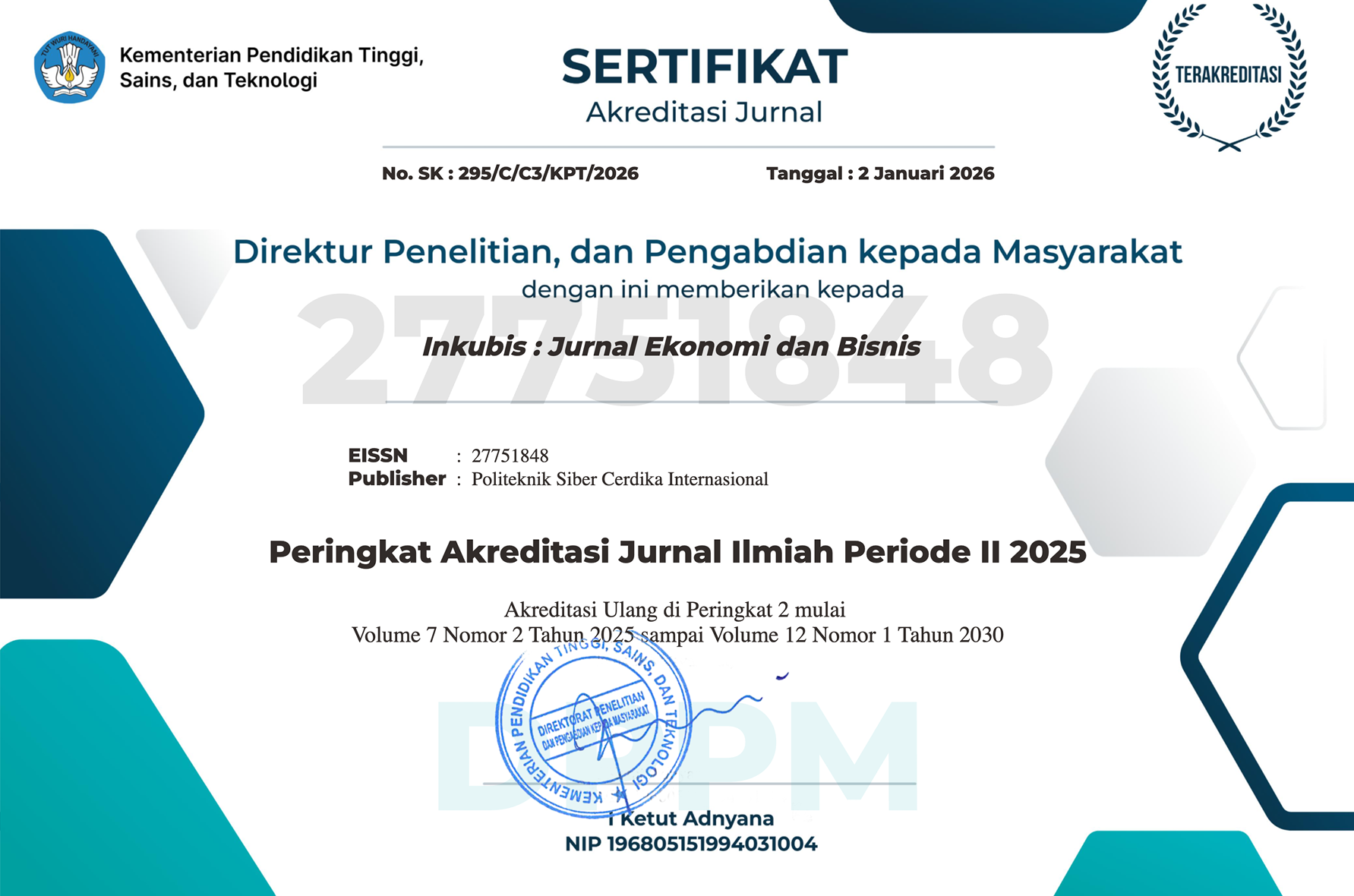
Controller as User of Technology and Developer of Workforce Strategy are the Internal Control Succeed Pillars
DOI:
https://doi.org/10.59261/inkubis.v8i2.223Keywords:
Controller, Internal Control Succed, Technology Usage, Workforce DevelopmentAbstract
Background: Internal control systems are essential for ensuring organizational accountability, risk mitigation, and operational efficiency in higher education institutions. The increasing adoption of digital technologies and the evolving role of internal auditors require controllers as users of technology and developers of workforce strategy to possess not only technological competencies but also strategic workforce management capabilities.
Objective: This study aims to analyze the influence of controllers as workforce strategy developers, trusted advisors, value-added providers, and technology users on the success of internal control at State Universities in Indonesia.
Method: This study employed a sequential explanatory mixed-methods design. Quantitative data were collected from 56 internal auditors at Indonesian State Universities and analyzed using PLS-SEM, followed by qualitative interviews with senior auditors to support the interpretation of findings.
Results: The bootstrapping results of the PLS-SEM analysis indicate that controllers as workforce strategy developers and technology users have a significant positive influence on internal control success. In contrast, the roles of controllers as trusted advisors and value-added providers were not found to have significant effects. The coefficient of determination (Adjusted R² = 72.20%) demonstrates that the independent variables strongly explain variations in internal control success. Qualitative findings further reveal that workforce development, technology infrastructure, audit data analytics, and information governance are critical factors supporting effective internal control implementation.
Conclusion: The study concludes that workforce strategy development and technology utilization significantly support the success of internal control in Indonesian State Universities, while the roles of trusted advisors and value-added providers do not show significant influence.
Downloads
Downloads
Published
Issue
Section
License
Copyright (c) 2026 Inkubis : Jurnal Ekonomi dan Bisnis

This work is licensed under a Creative Commons Attribution-NoDerivatives 4.0 International License.

This work is licensed under a Creative Commons Attribution-NoDerivatives 4.0 International License.